Interest Rate Arbitrage. Why 5.53% is a wake-up call for portfolio overhaul, not just cheaper borrowing?
📉 MPC Pause & Hedging Against the “Second Wave” of Inflation
Market Status: January 25, 2026
The latest Monetary Policy Council (MPC) meeting sent a clear, cold signal to the markets: the cycle of interest rate cuts has been paused. If your debt management strategy relied on the hope for further WIBOR declines, the moment for a course correction has arrived.
From the Author:
As a professional and a private investor, I feel obliged to inform you when, by “listening” to the market, I detect symptoms that are concerning—not just in my assessment, but in the eyes of many legendary economists and investors. This is definitely another such moment.
In 2021, just before interest rates in Poland skyrocketed, my clients were already safe—transferred to fixed rates ranging from 3.X% to 4.1% (I personally service such a mortgage). Back then, I also personally reached out to everyone, sharing concerns, predictions, and hard data so they could make informed decisions. The result? Hundreds of thousands of PLN in savings thanks to “hibernating” the cost of debt at a level 2-3 times lower than subsequent market realities. Today, seeing the risk of a second wave of inflation, I once again suggest prudence, even though rates might irrationally be lowered for some time.
— Jacob Adam
Market Intelligence: What’s “Under the Hood” of the Economy?
Macroeconomic Horizon: More Than Just Bank Tables
As your partner in wealth management, I analyze not just current banking offers, but primarily the broader macroeconomic horizon. Legendary investor Ray Dalio has repeatedly warned about the cyclical nature of history. Currently, we are observing a resurgence in the commodities and metals market—particularly gold, silver, and uranium. Historically, this has been a leading indicator, which in the past (e.g., the 1970s) heralded the return of inflation in subsequent waves.
Foundations of Money (The Nixon Shock)
In our consultations, I consistently repeat: assess the World yourself. A key moment for understanding today’s economy was 1971, when the US abandoned the gold standard (the collapse of the Bretton Woods system). Since then, we have lived in a fiat money system, where supply can be increased without physical limits.
That is why I emphasize the divergence between official CPI inflation and the real loss of purchasing power, which official statistical baskets often fail to fully reflect (ignoring, for instance, asset price inflation). An objective indicator worth watching is the M2 money supply (for PLN and USD). This is crucial because Poland imports energy and raw materials primarily based on the dollar.
The Wealth Illusion vs. Hard Data
One only needs to overlay the price of gold, M2 money supply, and the S&P 500 index on a chart to understand the nature of nominal growth. We are often dealing with the so-called “money illusion”—valuations rise, but real wealth (relative to gold) remains stagnant. The Cantillon Effect is also at play here: newly created money first boosts valuations in financial markets before (if ever) reaching the pockets of the average consumer.
Conclusions & Strategy: Asymmetric Risk
Personally, I question the market optimism regarding rapid rate cuts. Rationally analyzing real negative interest rates, the cost of money should be higher to effectively defend its value. Unfortunately, due to sovereign debt, politics often wins over fundamental economics.
My Point:
Since we do not know the future, and we are managing life savings, minimizing risk seems the rational choice. In the current environment, I treat the choice of a fixed interest rate as a form of “insurance policy” that we can optimize in the future if the black scenario does not materialize. However, it is better to be secured against a scenario that history has written many times before.
💡 What is Mortgage Refinancing?
It is the cashless transfer of your current loan to another bank. The New Bank pays off your Old Loan, and you gain a new contract with a lower installment, a fixed interest rate, and often a refund of initial costs. It is a “reset” of your debt on 2026 terms.
📥 Top Offers Report: January 2026
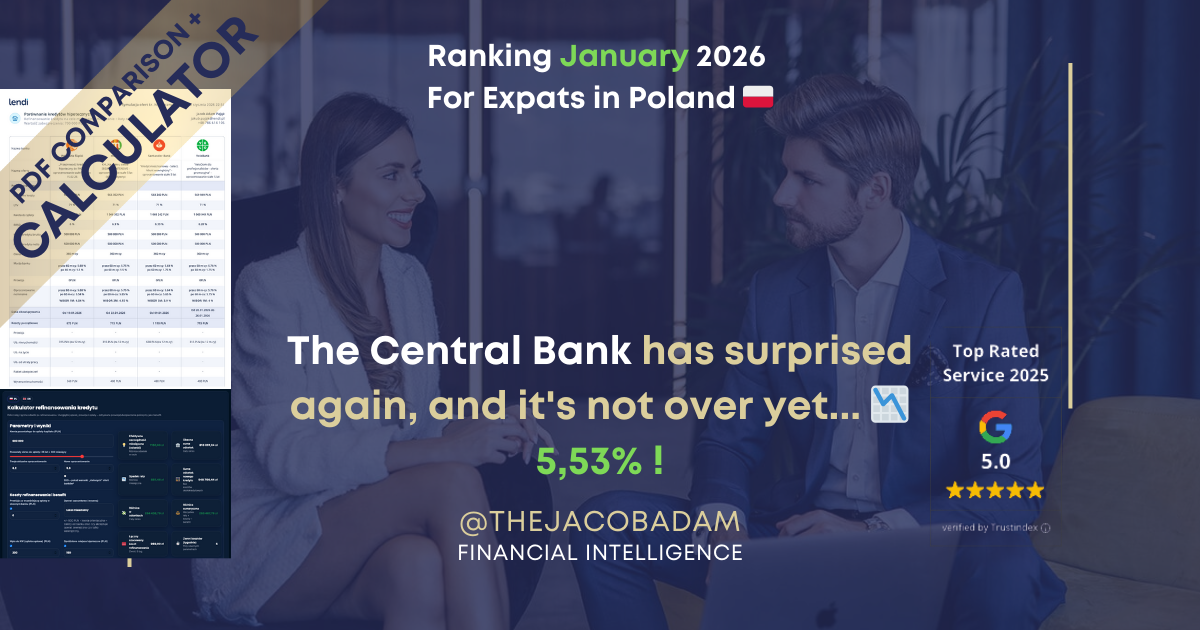
Download the complete, 14-page report with offer details for a volume of 500,000 PLN.
✅ 👉 DOWNLOAD FULL REPORT (PDF)DATA VERIFIED: 25.01.2026
The Savings Mechanism
Simulation for 800,000 PLN (LTV 71%). See how optimization changes your debt structure.
(Principal repayment vs Interest)
The 60-Month Logic: Why We Look at the “Here and Now”
Many experts focus on the total cost of the loan over 30 years. This is a methodological error. In an era of volatility, the only certainty is the fixed interest rate period. We do not know where WIBOR will be in 5 years. That is why at Harveo Finance, we sort offers based on the real monthly burden over the next 5 years.
Detailed Offer Analysis
🦁 ING Bank Śląski (“Cost Leader”)
Top for B2B/Lump SumFor Investors and Clients for whom mathematics is the sole determinant of success. This month, an unrivaled offer in terms of TCO (Total Cost Ownership).
- 🔒 Fixed Rate (5 years): 5.68%
- 💰 Total Cost: 546 959 PLN (lowest on the market)
- 💳 Commission: 0 PLN
Harveo Analysis: A “no-nonsense” offer. No unnecessary products, a pure play for the lowest cost of money.
🟢 VeloBank (“For Professionals”)
Industry SpecializationThe banking sector rewards the stability of public trust professions. VeloBank maintains its leadership position in risk profiling for experts.
- 🔒 Interest Rate: 5.78%
- 🩺 Medical Sector: incl. Doctors, Dentists, Vets, Psychologists, Physiotherapists.
- 💻 IT Sector: incl. Programmers, System Architects, Data Analysts.
- ⚖️ Legal Sector: incl. Lawyers, Notaries, Auditors.
*Full, detailed list of professions available in the attached PDF.
🏛️ Santander Bank Polska (“Select & Expats”)
High IncomeLeader in low nominal interest rate (5.64%). Offer available for clients meeting Select segment conditions:
- Account inflows: min. 10 000 PLN (single) or 15 000 PLN (household).
- Or assets in the bank min. 150 000 PLN.
🌈 mBank (“Lowest Start-up Costs”)
Proposition for active bank clients (Segment Intensive).
- 🔒 Fixed Rate: 5.75% (Standard)
- 📉 Active Client: Possibility of negotiation with additional products.
Cost Analysis: mBank is most attractive for quick and comfortable transfers (short investment horizon). This bank pays the mortgage entry cost (350 PLN) itself and offers a very cheap property valuation (400 PLN). An ideal solution if you assume rates will drop again in the near future and plan to refinance again.
🟣 Bank Millennium (“Safe Universal”)
Often the best “universal” choice for clients who do not fall into specific segments (don’t have 15k inflows, aren’t doctors/IT). Offers solid conditions without stringent cross-selling requirements.
Traps & Limitations: PEKAO S.A.
🔴 The Low Rate Illusion (5.53%)
On paper, the “Live Peacefully with CPI” offer looks attractive with an interest rate of 5.53%. However, this is a mathematical trap.
- Required expensive CPI insurance: The cost is as much as ~9 828 PLN (for 500k), which is financed/added to the loan.
- Effect: Instead of repaying 500 000 PLN, your capital grows to 509 828 PLN at the start, on which you pay interest. The real cost is significantly higher than the nominal rate suggests.
🏆 Cashflow Ranking (Monthly Cost)
Simulation for 500,000 PLN amount. Sorted by: Installment + Life Insurance.
| Bank | Rate | Installment | Life Ins. | TOTAL |
|---|---|---|---|---|
| Santander (Select) | 5.64% | 2 883 | 175 | 3 058 PLN |
| ING Bank Śląski | 5.68% | 2 896 | 175 | 3 071 PLN |
| VeloBank (Pro) | 5.78% | 2 927 | 151 | 3 078 PLN |
| Bank Millennium | 5.75% | 2 918 | 175 | 3 093 PLN |
| mBank (Intensive) | 5.75% | 2 918 | 250 | 3 168 PLN |
🧩 Individual Approach
The above ranking is a starting point. There is no single “best” bank for everyone. For one client, the lack of high inflow requirements will be key (Millennium), for another, process speed (mBank), and for an IT professional – special margin conditions (VeloBank).
🧠 Holistic Summary
Looking at the table, financial differences are marginal (~100 PLN/month). Often, “peace of mind,” no need to monitor inflows, and a good mobile app are worth more than fighting for every single penny.
0️⃣ Full Repayment Freedom (0% Commission)
All the above offers guarantee 0% commission for early repayment and overpayments from the first day of the contract. This is crucial – if interest rates drop in 1-2 years, we will refinance the loan again without exit costs.
🧮 Calculate Your Savings Yourself
Want to know the precise calculations for your specific loan amount?
👉 GO TO REFINANCE CALCULATOR💰 Commission Refund (Cashback)
Refinancing is not just a lower installment tomorrow. It is also recovering what you paid yesterday. In accordance with the Court of Justice of the European Union ruling (judgment C-383/18, the so-called “Small CJEU”), in the event of early loan repayment, the bank must settle with you proportionally to the day. This applies to every cost incurred at startup – in particular bank commissions and insurance paid upfront (e.g., job loss or life insurance) for the entire period.
Optimize Your Capital with Jacob
At Harveo Finance, we don’t sell “products.” We design financial strategies.
📅 BOOK A FREE CONSULTATIONLet’s verify your options for January 2026.